


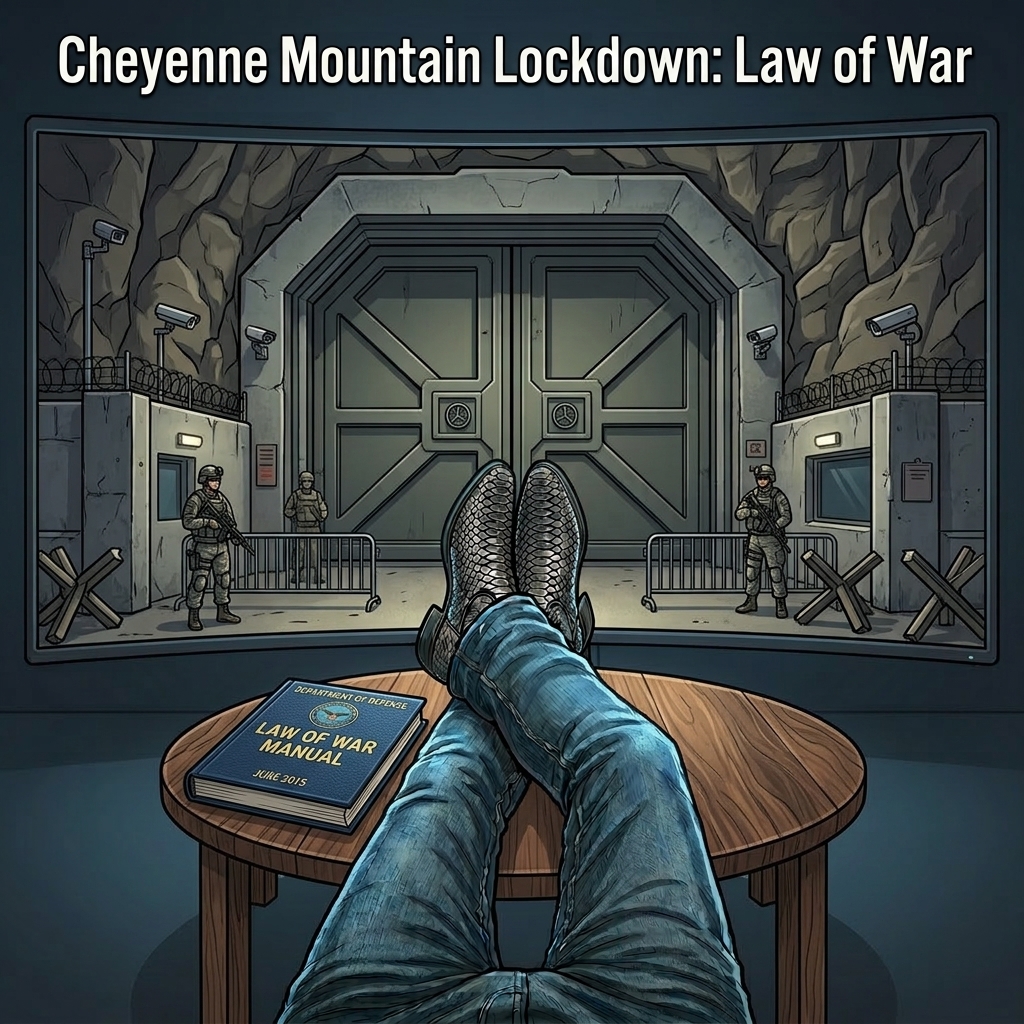

Transmission 153 opens a rigorous, data-driven forensic examination into one of the most significant strategic pivots in modern military history: the operational isolation of the Cheyenne Mountain Complex in mid-March 2020. Set against the backdrop of a rapidly unfolding global emergency, the physical sealing of America’s primary nuclear-hardened command center signaled a dramatic activation of Continuity of Operations (COOP) protocols. Public narratives framed the event as a prudent biological containment measure to insulate critical defense watch-teams from a novel viral threat. Simultaneously, alternative intelligence channels and political commentators asserted that the mountain was secured under wartime authority in response to an unconventional asymmetric attack on the homeland. From the analytical command center of Shadow Security, we audit the convergence of executive emergency powers, military doctrine, command-and-control infrastructure, and perception management to separate verifiable strategic maneuvers from speculative mythology.
To understand the structural significance of Cheyenne Mountain, one must evaluate the operational mechanics of state preservation during existential crisis. National command authority does not rely on political optics; it relies on hardened subterranean nodes designed to survive electromagnetic pulses, nuclear blasts, and cybernetic decapitation strikes. When executive orders align with immediate military isolation, the line between public health protocols and national defense posture becomes intentionally blurred. Dissecting these operational shifts requires analyzing legal frameworks, Northern Command (NORTHCOM) directives, and the broader intelligence footprint that governed the spring of 2020. By establishing a clear baseline of physical facts, military doctrine, and public reporting, the sovereign operator learns to read true command signals from the quiet vantage point of the Observer’s Chair.
I. The March 2020 Timeline: National Emergency Declarations and Military Isolation
The sequence of events unfolding in mid-March 2020 represents an unprecedented synchronization of civilian executive action and strategic military posture. On March 13, 2020, President Donald Trump officially issued a national emergency declaration under the Robert T. Stafford Disaster Relief and Emergency Assistance Act, alongside invoking the National Emergencies Act. This dual declaration unlocked extensive executive authority, granting federal agencies broad latitude to reallocate capital, mobilize defense assets, and streamline administrative chains of command. Within hours, public life across the nation entered a rapid contraction, marked by domestic travel restrictions, supply chain disruptions, and emergency administrative directives.
Concurrently, within the military apparatus, General Terrence O’Shaughnessy—commander of U.S. Northern Command (NORTHCOM) and the North American Aerospace Defense Command (NORAD)—executed a series of highly classified operational directives. Key among these was the decision to split critical watch-standing teams and seal essential personnel inside the granite-shielded fortress of the Cheyenne Mountain Complex near Colorado Springs, Colorado. Additional teams were deployed to undisclosed secondary bunker locations to create redundant, isolated command nodes. The official military rationale was straightforward: ensure that the core teams responsible for monitoring North American airspace, ocean approaches, and strategic nuclear threats remained completely uncompromised by biological contamination.
While biological isolation was the explicitly stated objective, the tactical execution mirrored classic military responses to asymmetric warfare scenarios. Sealing a command facility behind 25-ton blast doors is an extreme, capital-intensive maneuver reserved for high-level threats to state continuity. The timing of the national emergency declaration, occurring almost simultaneously with the physical isolation of NORAD personnel, generated an immediate rift between official press briefings and informal intelligence assessments. Analyzing this timeline requires examining whether the biological threat served as the sole driver or as an operational catalyst that accelerated broader, pre-planned Continuity of Government (COG) protocols designed under Frequency Guard.
The convergence of these events highlights the dual-use nature of modern crisis management frameworks. When a government invokes emergency legislation, the boundary between civil administration and defense readiness becomes highly permeable. Orders issued under the umbrella of public health automatically interface with defense readiness defense conditions (DEFCON) and executive continuity plans. Understanding the March 2020 timeline requires recognizing that high-level command structures are designed to prepare for worst-case scenarios—including foreign sabotage or strategic decapitation—regardless of how the crisis is framed in consumer news feeds.
II. Architecture of Cheyenne Mountain: Electromagnetic Hardening and COOP Logic
To appreciate why Cheyenne Mountain remains the apex symbol of military continuity, one must understand its engineering and strategic purpose. Constructed deep beneath 2,000 feet of solid granite during the height of the Cold War, the bunker was engineered to withstand a multi-megaton nuclear blast, direct kinetic strikes, and intense electromagnetic pulse (EMP) emissions. The facility houses fifteen three-story steel buildings mounted on massive coil springs designed to absorb seismic shockwaves. It operates as an entirely self-contained ecosystem equipped with independent power generation, water filtration, air scrubbing systems, and multi-layered communication arrays.
Although primary NORAD operational headquarters were officially shifted to Peterson Air Force Base in 2006 for cost efficiency and modern administrative convenience, Cheyenne Mountain was never decommissioned. Instead, it was designated as an alternate command center and retrofitted with advanced sensors, cybernetic defense nodes, and secure communications gear. The mountain functions as an ultimate fail-safe: if surface infrastructure, power grids, or unhardened bases are neutralized by cyber warfare, kinetic strikes, or societal collapse, Cheyenne Mountain retains the ability to monitor defense perimeters and execute command directives without external support.
The logic of Continuity of Operations (COOP) mandates that critical defense capabilities must survive any eventuality. Under standard Department of Defense instructions, COOP plans are triggered when an emerging threat endangers operational integrity. In March 2020, the deployment of NORTHCOM personnel back into the granite mountain demonstrated that military leadership viewed the unfolding crisis as a potential threat to national command infrastructure. insulating critical personnel within a self-sustaining subterranean fortress ensured that North American threat monitoring would remain online even if surface installations suffered widespread operational failure.
Furthermore, Cheyenne Mountain’s unique electromagnetic shielding provides absolute defense against signal interception and electronic disruption. In an era dominated by hybrid warfare—where electromagnetic pulse weapons, satellite blinding systems, and high-level cyber intrusion pose constant threats—the facility offers an unhackable physical environment. Securing watch-teams behind massive steel doors is not merely a defense against microscopic biological agents; it is an absolute isolation protocol designed to preserve decision-making integrity during periods of extreme geopolitical volatility, keeping historical records clear within The Receipt Ledger.
Forensic Audit: Deconstructing Emergency Military Directives
To evaluate state actions during national emergency declarations, apply these five analytical criteria:
1. Legal Base Verification: Cross-reference executive orders against statutory authorities (e.g., Stafford Act, Insurrection Act, National Emergencies Act) to identify true jurisdictional shifts.
2. Physical Asset Tracking: Monitor the real-world deployment of strategic defense assets, subterranean facilities, and specialized command units rather than relying on press statements.
3. Redundancy Auditing: Identify secondary and tertiary command nodes activated during a crisis to determine the perceived threat level to primary installations.
4. Information Asymmetry Analysis: Measure discrepancies between public-facing administrative guidance and internal defense readiness directives.
5. Signal Disconnection: Strip away media spin and political commentary to focus strictly on physical logistics, troop movements, and facility isolation via The Zero Point.
III. Claims vs. Documented Realities: Decoding the Narrative Architecture
Following the March 2020 events, a distinct alternative narrative emerged across online intelligence networks and civic commentary groups. Central to this narrative were claims popularized by commentators such as Juan O Savin, who asserted that President Donald Trump had personally visited Cheyenne Mountain around March 13, 2020, inspected the facility, determined that the United States was under an asymmetric foreign attack, and placed the nation on a covert wartime footing under the Law of War manuals. In these claims, the physical isolation of the mountain was presented as a pivotal tactical move in an ongoing, unacknowledged military conflict.
When evaluated through a strict forensic lens, a clear distinction emerges between verifiable physical records and speculative interpretation. Official flight logs, executive movement schedules, and white house press records from mid-March 2020 show no public documentation of a presidential visit to Colorado Springs during that specific timeframe. Instead, official logs reflect intense executive activity in Washington D.C., including press briefings, legislative negotiations, and task force meetings. The operational order to isolate NORAD watch-teams was publicly announced by General Terrence O’Shaughnessy during a Pentagon press briefing, attributing the action directly to NORTHCOM biological protection protocols.
However, the rapid spread of the alternative narrative highlights a profound structural reality: the public’s deep distrust of standard media explanations during times of national crisis. When official institutions issue blanket declarations, citizens frequently seek underlying strategic explanations that align with historical patterns of statecraft. The concept of an unacknowledged war or covert military operation resonates because modern warfare has fundamentally shifted away from formal declarations of war toward hybrid, cybernetic, and biological domains where attack vectors are intentionally obfuscated.
Analyzing these competing perspectives requires maintaining balanced analytical rigor. While unverified claims of presidential visits lack primary documentation, the underlying reality—that the military activated high-level COOP protocols and sealed nuclear-hardened command centers—is an undisputed historical fact. The operator must separate speculative storytelling from hard operational mechanics, recognizing that state entities routinely utilize cover stories to conceal true readiness levels while executing strategic defense shifts under the umbrella of Celestial Mechanics.
IV. Executive Authority and the Framework of Asymmetric Warfare
The legal and operational landscape of emergency executive authority in the United States is governed by a complex web of constitutional provisions, statutory frameworks, and highly classified presidential directives. When a President declares a national emergency, it triggers hundreds of dormant statutory powers ranging from asset seizure and communication control to the mobilization of national guard forces under federal control. In times of perceived existential threat, these powers provide the executive branch with near-total administrative latitude to safeguard state continuity.
Modern defense doctrine explicitly recognizes that 21st-century conflict rarely begins with traditional troop deployments or naval blockades. Asymmetric warfare encompasses cyber warfare, economic sabotage, information warfare, electromagnetic manipulation, and biological weapons deployment. Within this framework, a nation can sustain a catastrophic strategic strike without a single missile being launched. Consequently, defense protocols dictate that command structures must react to asymmetric threats with the same speed and severity as traditional kinetic attacks.
The Department of Defense Law of War Manual provides comprehensive guidelines for how military forces operate during recognized conflicts, occupation, and national defense emergencies. Under these guidelines, the protection of national command authority is paramount. If military leadership suspects that an unconventional event—such as a global pandemic—may be leveraged by foreign adversaries to weaken domestic readiness, defense forces are obligated to execute protective isolation measures immediately. The sealing of Cheyenne Mountain in March 2020 fit squarely within this doctrine of preventative state defense.
Furthermore, the use of emergency powers often involves covert coordination between civilian intelligence agencies and military commands. When executive declarations are issued, parallel operational plans are quietly initiated across various federal departments. Whether designated as a public health response or a national defense posture, the practical outcome is identical: centralized control, heightened security protocols, and the deployment of continuity assets designed to keep the sovereign core of government intact while monitoring Sovereign Healing.
V. Perception Management, Information Operations, and Public Trust
The management of public perception during national emergencies is a critical component of state strategy. Information operations are designed to maintain social order, prevent panic, and control the flow of strategic intelligence. When major military installations like Cheyenne Mountain undergo sudden operational shifts, official communication teams carefully curate public statements to project calm, competence, and routine precautionary intent.
During the spring of 2020, media networks focused almost exclusively on the administrative and biological aspects of the crisis, downplaying or ignoring the broader military maneuvers occurring in the background. This narrative funneling served a dual purpose: it focused public attention on domestic compliance measures while allowing defense entities to reconfigure command structures without drawing intense international scrutiny. By framing every defense action as a standard health precaution, military leadership maintained maximum operational flexibility while minimizing public anxiety.
Conversely, alternative media ecosystems filled the information vacuum by constructing elaborate narratives around military intervention, secret tribunals, and covert warfare. These narratives gained massive traction because they provided a structured explanation for the extraordinary, surreal events taking place globally. For millions of citizens living under sudden lockdowns, the idea that a hidden military operation was underway offered a sense of purpose and underlying order amidst chaos.
Understanding this dynamic requires recognizing that both institutional media and alternative commentary networks operate as perception channels. Institutional media minimizes strategic military realities to preserve civic order, while alternative channels often sensationalize factual events to fit ideological frameworks. The discerning analyst must navigate between these two poles, auditing raw physical data, legal declarations, and tangible asset movements to discern the true operational reality, protected under The Unspoken Bond.
VI. The Legacy of 2020: Permanently Altered Defense Postures
The events of March 2020 permanently reshaped the architecture of domestic defense and operational readiness. The successful activation of Cheyenne Mountain and secondary isolated facilities demonstrated that modern COOP plans are fully functional and capable of executing rapid physical isolation under real-world crisis conditions. It proved that defense commands can decouple from surface infrastructure and maintain operational integrity despite global disruptions.
Moreover, the crisis highlighted the critical vulnerabilities inherent in complex, interconnected global systems. Supply chains, digital communication networks, and civilian medical infrastructure proved highly fragile when subjected to sudden systemic shocks. In response, military leadership accelerated efforts to harden defense infrastructure against hybrid threats, placing renewed emphasis on decentralized command nodes, sovereign energy independence, and unhackable communication channels.
For the sovereign individual, the legacy of 2020 serves as a masterclass in operational self-reliance and threat awareness. The sight of major nations shutting down domestic economies and locking down nuclear command facilities proved that stability is far more fragile than consumer culture suggests. True security requires building personal redundancy, maintaining cognitive independence, and cultivating the ability to evaluate high-level geopolitical shifts without falling prey to systemic panic or ungrounded speculation.
As global dynamics continue to evolve toward heightened multipolar competition and rapid technological change, the protocols established during the March 2020 crisis remain active baselines. Subterranean command centers remain fully upgraded, emergency legal frameworks remain tested and operational, and the intelligence apparatus continues to monitor hybrid threat vectors. The mechanisms of state survival are permanently primed, ready to execute isolation directives at the first signal of systemic instability.
VII. Operational Protocol: Navigating State Emergencies as a Sovereign Analyst
How does the sovereign operator maintain clarity and stability when state entities execute emergency isolation protocols and public narratives collapse into noise? The process requires adopting a disciplined, objective framework centered on personal sovereignty, empirical observation, and emotional detachment.
First, establish absolute analytical discipline. When emergency declarations are issued, disregard immediate media commentary and emotional appeals. Focus strictly on primary source materials: official executive orders, statutory references, physical military deployments, and verified infrastructure shifts. Track what physical assets are moving and where command personnel are consolidating. By anchoring your analysis in tangible physical data, you insulate your mind from narrative manipulation and artificial panic.
Second, build internal operational redundancy. Just as military command structures maintain secondary subterranean facilities to survive systemic failure, the sovereign individual must construct physical, financial, and informational redundancy. Secure independent access to essential resources, establish offline communication channels, and maintain an unshakeable psychological core that remains stable regardless of external societal contractions.
Third, cultivate complete cognitive sovereignty. Recognize that during national crises, both state institutions and alternative media networks deploy intense psychological operations to direct public energy and secure compliance. Refuse to be drawn into artificial ideological polarization or unverified conspiracy theories. Maintain your seat in the analytical command center of your own consciousness, observing global developments with cold, clear discernment as you navigate the road toward the Final Transition.
VIII. Terminal Protocol: Summary of Strategic Realities
Transmission 153 brings us to the ultimate operational synthesis: the isolation of Cheyenne Mountain in March 2020 was a historic, physical activation of state continuity protocols executed under real-world emergency conditions. While public narratives framed the event around biological protection and alternative commentators claimed covert military warfare, the underlying factual reality proves that state defense entities prepared for total systemic shock by securing their most resilient command assets.
Stand firm in your analytical posture. Dissect official declarations with sharp legal scrutiny, evaluate physical asset movements with empirical precision, and reject both institutional obfuscation and ungrounded mythology. The era of passive reliance on public narratives has ended. Clear-eyed, sovereign operators now stand prepared to read true operational signals, commanding their personal timelines with absolute clarity, grounded intelligence, and unyielding independence. “.”