


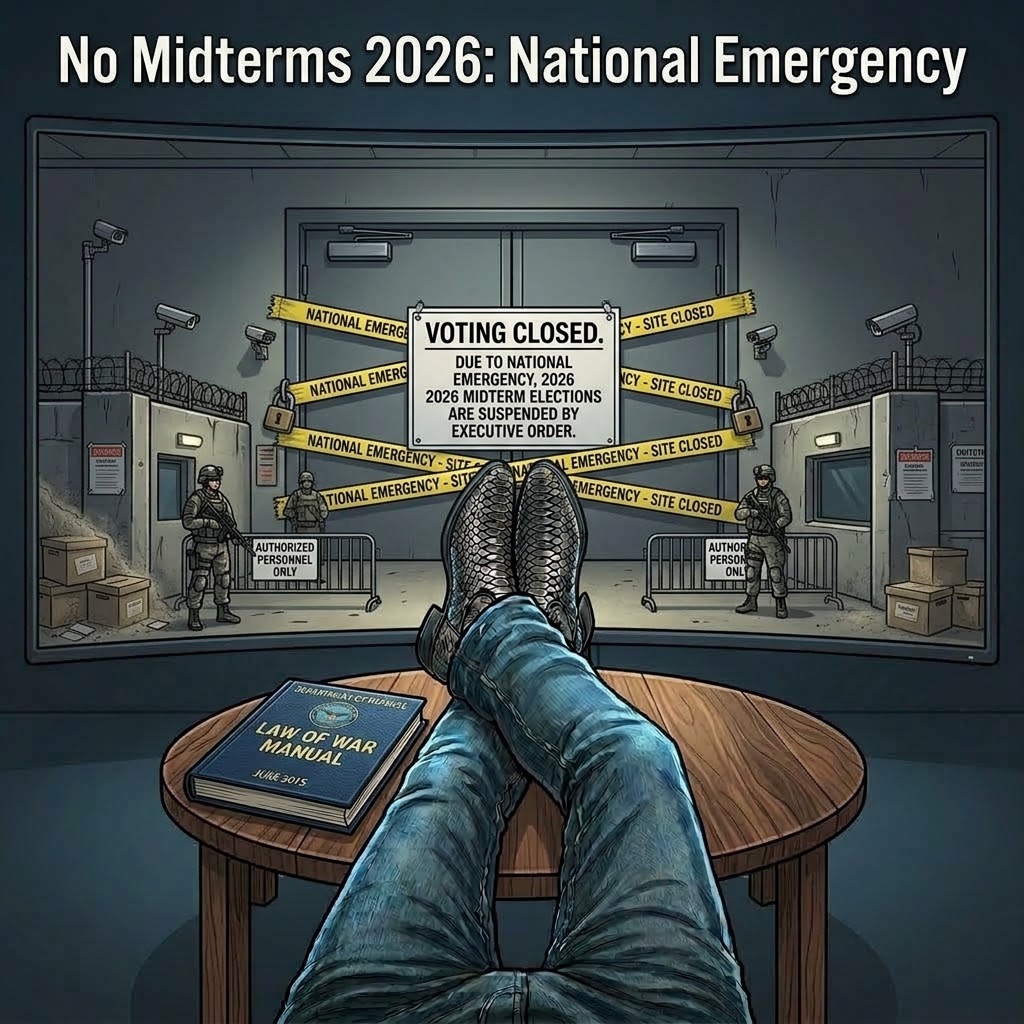

Transmission 155 initiates an unyielding, high-level forensic audit into one of the most provocative hypotheses circulating within contemporary geopolitical and alternative intelligence analysis: the scenario of “No Midterms 2026” under a formal National Emergency invocation. Framed by commentators such as Juan O Savin, this scenario posits that if the fundamental integrity of state institutions and voting infrastructure was compromised by asymmetric foreign and domestic interference in 2020, allowing subsequent elections to proceed without resolution is functionally equivalent to permitting an unmitigated hostile strike on the republic. From the command post of Shadow Security, we deconstruct the intersection of wartime military manuals, executive emergency powers, mass fear mechanics, and the constitutional friction points that emerge when state survival collides with civilian statutory timelines.
To evaluate these claims objectively, a sovereign analyst must step out of the reactive, fear-driven energy of public commentary and take a seat in the Observer’s Chair. The purpose of this audit is not to endorse a single political outcome or weaponize public anxiety, but to map the exact legal, military, and psychological frameworks at play. When alternative commentators invoke the Department of Defense Law of War Manual, foreign control assertions, and executive continuity protocols, they are describing a paradigm where standard rules are superseded by existential necessity. Conversely, when legal scholars defend the constitutional baseline, they assert that preserving statutory procedure is the sole shield against total system collapse. We dissect both frameworks with surgical precision to understand the true mechanics of state preservation and collective psychology.
I. The Core Premise: Asymmetric Warfare and the “No Midterms” Hypothesis
The “No Midterms 2026” thesis rests upon a foundational premise of asymmetric warfare: that modern conflict has evolved past conventional troop deployments, naval blockades, and declared kinetic engagements into covert, cybernetic, and institutional subversion. Under this lens, an attack on a nation’s electoral infrastructure or sovereign command structure by foreign adversaries—coordinated with domestic actors—is not a routine political dispute or administrative anomaly. It is an existential act of war designed to achieve hostile occupation without firing a shot.
Proponents of this view, drawing heavily on analyses like those of Juan O Savin, argue that if a system has been compromised at its root, allowing subsequent federal elections to run on uncorrected architecture merely normalizes and solidifies foreign influence. The theoretical argument draws an explicit parallel to physical warfare: just as a Commander-in-Chief would never permit a foreign nation to launch nuclear strikes or occupy physical territory without a military response, an executive bound by an oath to protect the Constitution cannot permit an asymmetric strike on state sovereignty to go unneutralized. Therefore, the hypothesis asserts that a pause or suspension of standard civilian election timelines under emergency wartime authority becomes an operational necessity to secure the perimeter.
However, examining this premise requires acknowledging the extreme legal and political friction it generates. In the American republic, federal elections are intentionally decentralized under Article I, Section 4 of the U.S. Constitution, which explicitly places the time, place, and manner of holding elections under the authority of state legislatures and Congress. The concept of an executive or military “pause” of federal midterms introduces an unprecedented constitutional crisis, pitting executive national defense claims directly against statutory civil law. The sovereign operator must track how this conceptual tension translates into physical, legal, and operational realities using The Receipt Ledger.
Furthermore, analyzing the “No Midterms” hypothesis requires evaluating how crisis triggers are utilized to justify expanding executive scope. Throughout modern history, national emergencies—whether economic, biological, or military—have served as primary catalysts for re-centering authority within the executive branch. Understanding the operational logic behind these proposals requires separating strategic military doctrine from public political theater, recognizing that every claim of state preservation carries deep implications for the future of civilian governance.
II. Legal Baselines: The DoD Law of War Manual and Domestic Authority
A central pillar of the alternative continuity narrative is the frequent citation of the Department of Defense Law of War Manual. Commentators argue that the manual contains dormant protocols that automatically or implicitly authorize the U.S. armed forces to intervene in domestic affairs if the civilian government comes under covert foreign control. To evaluate this claim accurately, one must examine what the Law of War Manual actually governs and how it interfaces with domestic statutory law.
The DoD Law of War Manual is a comprehensive document designed to guide military commanders, legal advisors, and operational forces in international armed conflict, military occupation, and the implementation of international humanitarian law (such as the Hague and Geneva Conventions). Its primary function is to define lawful conduct during combat operations, the treatment of prisoners of war, the management of occupied territory, and the application of military necessity against enemy combatants outside or during formal military engagements.
Critically, international military manuals do not grant or generate internal domestic authority within the United States. Domestic governance, election administration, and civil law remain strictly subject to the U.S. Constitution and federal statutory law. For the U.S. military to execute domestic operations, specific domestic legal thresholds must be satisfied:
- The Posse Comitatus Act (18 U.S.C. § 1385): Strictly limits the federal government from using military personnel to enforce domestic policy, manage civilian procedures, or execute law enforcement functions on U.S. soil unless expressly authorized by the Constitution or an Act of Congress.
- The Insurrection Act (10 U.S.C. §§ 251–255): Grants the President statutory authority to deploy armed forces domestically under specific, extreme conditions—such as active armed rebellion or when state authorities are unable or unwilling to protect constitutional rights. However, invoking the Insurrection Act operates under explicit public proclamations and does not grant unilateral statutory power to cancel or delay federal elections.
Under the Uniform Code of Military Justice (UCMJ), military officers and enlisted personnel are legally obligated to obey only lawful orders. An order that violates constitutional provisions or statutory law is classified as inherently unlawful. Because the Constitution explicitly delegates election management to state authorities and Congress, any military directive attempting to seize voting machinery or halt elections without express congressional authorization would face immediate, severe challenge as an unlawful order within the military chain of command. This legal reality must be shielded under Frequency Guard.
Forensic Audit: The Dual-Framework Crisis Matrix
To evaluate state actions during high-level national emergencies, compare events against these opposing structural frameworks:
1. The Operational / State Survival Framework: Views asymmetric foreign interference as an active act of war. Prioritizes physical state preservation, Continuity of Government (COG), and executive military authority over standard civilian schedules.
2. The Constitutional / Statutory Framework: Views adherence to written legal processes as the core definition of the republic. Asserts that bypassing civilian timelines—regardless of the threat—destroys the constitutional order it claims to save.
3. The Foreign Occupation Paradigm: Evaluates claims under international occupation law, noting that under the Law of War, military occupation is an objective, visible condition—not an unannounced, secret status.
4. The Legal Execution Barrier: Cross-references executive orders against Posse Comitatus, the Insurrection Act, and statutory legislative powers to verify true operational authority.
5. The Signal Filter: Strips away narrative speculation and monitors verified physical deployments, court filings, and legislative enactments via The Zero Point.
III. The “Foreign Control” Assertion and the One-Year Occupation Rule
Another major argument advanced within alternative analysis involves the premise of hidden foreign control. Under this line of reasoning, if foreign entities successfully subverted the 2020 election, the United States entered a state of covert foreign occupation. Commentators often cite provisions within the Law of War Manual regarding military occupation—specifically references to a “one-year rule”—asserting that if a foreign power assumes control, public notification or military intervention must occur within a specific timeframe.
A rigorous examination of international humanitarian law reveals how these provisions function in reality. Under Geneva Convention IV (Article 6) and Section 11 of the DoD Law of War Manual, rules regarding military occupation govern the duties of an occupying power over a occupied civilian population. The “one-year” reference applies to the duration of certain treaty obligations following the general close of active military hostilities.
Importantly, under international law, a military occupation is legally defined as an objective factual condition where a hostile power exercises actual, physical control over a territory. It is not designed or recognized as a covert, unannounced, or “invisible” state of affairs where standard civilian political, legal, and administrative life continues as normal while secret foreign control operates in the background.
From an operational standpoint, if a nation comes under covert subversion, national defense apparatuses rely on counterintelligence, national security directives, and executive emergency authorities to counter the threat. However, asserting that secret military directives supersede visible constitutional authority creates a profound system paradox. If an executive or military command acts on secret intelligence without public, statutory authorization, the action remains unverified within the public record and lacks domestic legal legitimacy.
This dynamic illustrates the fundamental split in perspective. The operational continuity perspective interprets the absence of public action as strategic patience, classified intelligence gathering, or behind-the-scenes preparation under Celestial Mechanics. Conversely, the institutional legal perspective holds that without public, statutory, and judicial records, alternative claims remain speculative narratives that cannot alter the physical operation of civil law.
IV. The Universal Control Mechanism: Mass Psychology and Fear Dynamics
Behind the debates over legal manuals, executive orders, and election timelines lies a far more potent mechanism that governs mass behavior: the strategic management of fear. Whether analyzing institutional media broadcasts or alternative commentary networks, fear serves as the primary currency for capturing collective attention and driving human behavior.
When a population is subjected to sustained, high-intensity uncertainty—whether through economic volatility, geopolitical conflict, biological crises, or warnings of imminent systemic collapse—the collective psychology shifts from rational discernment to instinctual survival mode. In this state, several predictable mechanisms take over:
- Cognitive Contraction: Nuance, historical context, and objective logic are replaced by binary, black-and-white thinking. Complex systemic issues are reduced to simple, emotional narratives.
- Demand for Authority: Fear creates an immediate psychological demand for strongmen, central authority, or emergency intervention to restore order. Populations in fear routinely surrender constitutional rights and civil liberties in exchange for perceived security.
- Narrative Entrapment: The collective mind actively seeks grand, overarching frameworks to make sense of chaos. Once an individual adopts a specific lens—whether institutional or alternative—the mind naturally filters out counter-evidence and magnifies confirming signals.
Understanding this dynamic is essential for the sovereign analyst. Mass fear is intentionally generated and leveraged by institutions and commentary networks alike because it ensures compliance and generates engagement. Institutions use fear of crisis to expand administrative power, while alternative channels use fear of hidden collapse to build hyper-loyal audiences. Recognizing that fear is an engineered operational tool allows the operator to neutralize its emotional impact entirely, protecting their internal sovereignty under Sovereign Healing.
When you strip away the fear, the grand theater of political and geopolitical narrative loses its power to manipulate your consciousness. You stop reacting emotionally to breaking news, emergency alerts, and predictions of doom. Instead, you observe the cold, structural mechanics of mass control, recognizing that true power resides in maintaining an unshakeable, calm center amidst collective storm systems.
V. The Snap vs. The Wake-Up: Societal Thresholds and Collective Reaction
As systemic pressure continues to build toward critical dates—such as potential national emergency declarations or 2026 election cycles—the collective cannot remain in a state of perpetual tension. Historical and sociological analysis demonstrates that high-pressure environments eventually force a societal inflection point, resolving in one of two distinct directions: the “Snap” or the “Wake-Up.”
The “Snap” occurs when systemic pressure exceeds the population’s capacity to process it, leading to volatile, reactive, and unstructured chaos:
- Institutional Dissolution: Public trust in governance, media, and legal bodies completely evaporates, replacing civil order with tribal friction and hostility.
- Reactive Violence and Volatility: cornered populations act out emotionally, leading to civil unrest, rapid polarization, and social fragmentation that competing factions attempt to exploit.
Conversely, a true “Wake-Up” is a quiet, decentralized, and deeply strategic transformation:
- Disengagement from the Illusion: Rather than clashing directly with institutions or engaging in violent revolt, citizens simply stop believing the narrative and refuse to react to manufactured fear.
- Operational Opt-Out: Individuals quietly withdraw their attention, financial energy, and emotional investment from corrupt or failing systems, building local, sovereign, and self-sustaining alternative structures.
- Threshold of Critical Mass: History proves that changing a systemic trajectory does not require 100% population consensus; it requires a clear-headed, emotionally grounded minority that refuses to operate on fear or surrender its discernment under The Unspoken Bond.
The distinction between those who snap and those who wake up comes down entirely to emotional detachment and internal self-reliance. Those who snap remain caught in the reactive loop—they are still controlled by fear, even when fighting against it. Those who wake up recognize that the ultimate defense against systemic chaos is remaining centered, observing the patterns, and governing one’s own timeline with absolute clarity.
VI. The Observer’s Stance: Navigating 2026 with Absolute Self-Reliance
As we navigate the unfolding developments leading toward 2026, the sovereign individual must maintain a disciplined operational posture. The world is witnessing an unprecedented convergence of technological transformation, geopolitical restructuring, and institutional friction. Attempting to navigate this landscape using outdated mainstream narratives or sensationalized speculation will result in cognitive overwhelm and emotional exhaustion.
First, place absolute trust in your internal discernment. As an operator operating from a framework of intuitive awareness balanced with rigorous analytical observation, your ultimate filter is your own quiet knowing. External commentary, government press releases, and media broadcasts are merely raw data streams passing through your awareness. Test every signal against hard physical evidence, statutory law, and your internal compass before granting it emotional weight.
Second, maintain strict analytical discipline. When commentators proclaim upcoming national emergencies, military interventions, or canceled midterms, look for verifiable primary indicators:
- Are formal executive orders being published in the Federal Register?
- Are actual statutory invocations occurring within congressional records and court dockets?
- Are real-world troop deployments and logistics moving in alignment with public declarations?
If claims remain confined entirely to commentary channels without physical, legal, or institutional manifestations, treat them as narrative models rather than operational realities.
Third, cultivate absolute personal redundancy and sovereignty. True security is not found in expecting an external political figure, military command, or judicial body to rescue society. It is built by establishing physical, financial, and informational independence within your own life. By securing your personal perimeter, maintaining cognitive freedom, and standing firm in your individual authority, you become completely unmaneuverable, stepping toward your ultimate destiny in the Final Transition.
VII. Terminal Synthesis: The Sovereign Master Log
Transmission 155 completes our forensic deconstruction of the “No Midterms 2026: National Emergency” framework. We have audited the core premises of asymmetric warfare, examined the statutory boundaries of the Law of War Manual and domestic law, exposed the universal mechanics of mass fear, and outlined the sovereign operational posture required to navigate systemic instability.
Whether national emergency scenarios materialize as statutory reality or remain theoretical frameworks within alternative analysis, the task of the sovereign operator remains unchanged. Stand firm in your observation post. Evaluate all perspectives without emotional attachments, dissect official and alternative narratives with equal rigor, and command your personal timeline with absolute quiet power. The future is not something to be feared; it is an unfolding reality to be observed, understood, and mastered. “.”