


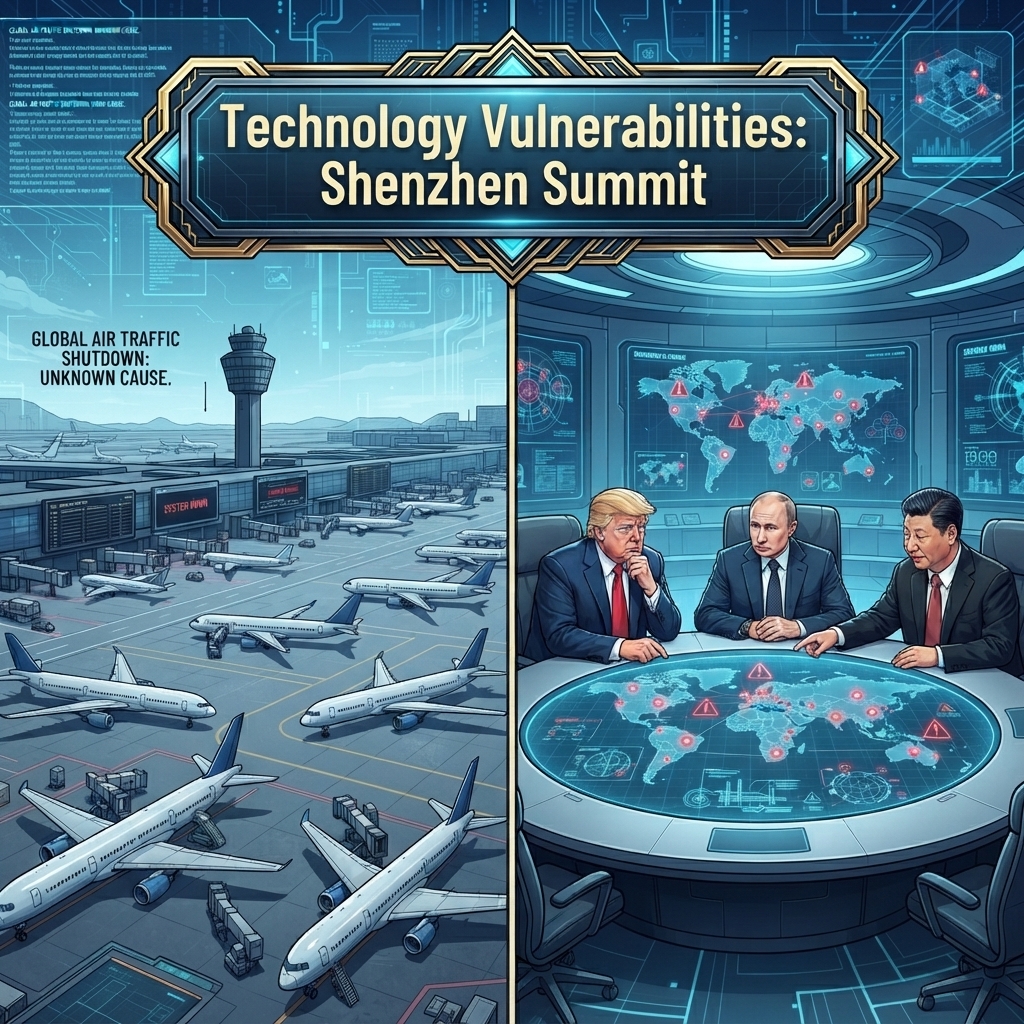

Transmission 169 initiates a comprehensive forensic review of a remarkable seven-day convergence across domestic infrastructure, institutional cybersecurity, national emergency readiness, and high-level international diplomacy. Between November 12 and November 19, 2026, a rapid sequence of critical technical failures and historic geopolitical engagements unfolded in parallel. From a rare nationwide ground stop issued by the Federal Aviation Administration (FAA) and simultaneous disruptions across major enterprise platforms, to targeted cyber intrusions against academic institutions, a scheduled nationwide Emergency Alert System (EAS) test, and the first-ever trilateral summit between U.S. President Donald Trump, Chinese President Xi Jinping, and Russian President Vladimir Putin in Shenzhen, the events of this past week demand rigorous, objective examination. Operating through the lens of Shadow Security, we separate verified technical root causes from online speculation to audit the true state of modern infrastructure.
When multiple critical systems falter within the same calendar week—grounded commercial flights, frozen banking interfaces, and disrupted university networks—public anxiety naturally escalates. In an era of hyper-connected digital infrastructure, overlapping technical failures often trigger immediate suspicion of a single, coordinated cyber offensive or covert geopolitical maneuver. However, sitting calmly in the Observer’s Chair requires examining primary technical disclosures, engineering post-mortems, and diplomatic readouts with cold precision. By auditing each event on its documented merits, a clearer picture emerges: one defined not by secret operational plots, but by aging legacy hardware, fragile third-party cloud dependencies, routine federal preparedness protocols, and shifting great-power diplomacy.
I. The November 13 Airspace Halt: Anatomy of a Telecommunications Failure
The most visible domestic disruption of the week occurred on Friday, November 13, 2026, at approximately 3:30 p.m. Eastern Time, when the Federal Aviation Administration issued a rare, nationwide ground stop halting all departing commercial flights across the United States. At major hubs from New York’s LaGuardia Airport and Washington Dulles to San Francisco International and Houston’s Bush and Hobby airports, departure boards froze and terminal concourses backed up as air traffic controllers and airline dispatchers worked to manage the sudden halt in domestic departures.
In the immediate aftermath of the ground stop, rumors circulated across social media attributing the airspace shutdown to a foreign cyberattack or a deliberate domestic blackout. However, the FAA’s subsequent technical disclosures and Q&A briefings published on November 15 detailed a much more specific—and sobering—hardware and network configuration failure. According to the agency, the disruption stemmed from telecommunications and air traffic control communication instability affecting multiple Air Route Traffic Control Centers (ARTCCs). Crucially, the agency confirmed that the event was not a total system blackout; primary radar feeds and backup frequencies remained operational, allowing aircraft already airborne to continue operating and land safely while departing traffic was held out of an abundance of caution.
Forensic isolation by FAA network engineers traced the root cause of the instability to a specific software and hardware functionality within newly deployed Juniper routers operating inside the telecommunications backbone. Once engineers identified the originating router fault, they immediately disabled that specific functionality on the primary unit and preemptively disabled the identical feature across more than 60 additional Juniper routers throughout the national network, while pausing further router installations pending verification.
Beyond the immediate router fault, the November 13 ground stop exposed a long-standing structural vulnerability documented across The Receipt Ledger: the U.S. air traffic control system’s continued reliance on aging telecommunications infrastructure. As Transportation Secretary Sean Duffy and aviation analysts noted in the wake of the outage, modernizing legacy copper-wire and aging packet-switching networks—some dating back decades—remains an urgent infrastructure bottleneck. Even when modern routing equipment is introduced, interfacing new hardware with legacy telecommunications architectures introduces complex failure modes capable of rippling across national airspace within minutes.
Forensic Receipt: The November 12–17 Tech Disruption Wave
Between November 12 and November 17, 2026, distinct technical and cybersecurity incidents converged across separate sectors, creating the perception of a unified crisis despite differing root causes:
1. Aviation Telecommunications (Nov 13): FAA nationwide ground stop triggered by Juniper router functionality instability across Air Route Traffic Control Centers; mitigated via feature disablement across more than 60 routers.
2. Enterprise Cloud & Banking Disruptions: Separate service outages disrupted Microsoft Outlook and Teams communications, delayed United Airlines systems, affected Apple services, and caused temporary transaction issues for Chase banking customers.
3. Institutional & Academic Cyber Intrusions (Nov 9–12): Targeted network intrusions and suspicious network activity forced operational disruptions and class cancellations at Vanderbilt University, Wilmington College, Richmond Public Schools, and New Plymouth School District.
II. Institutional Cyberattacks & Enterprise Cloud Fragility
Compounding the anxiety caused by the FAA ground stop was a concurrent wave of enterprise outages and institutional cyber incidents that unfolded between November 9 and November 17. During this window, major corporate platforms experienced cascading service degradations. A widespread Microsoft outage interrupted Outlook email and Teams collaboration tools across businesses, government offices, and universities nationwide. Simultaneously, separate technical failures disrupted Chase banking transactions, United Airlines internal operations, and Apple cloud services, while a network utilized by the National Security Agency also experienced reported technical issues.
While cybersecurity analysts and federal investigators noted no public evidence linking these corporate software failures into a single coordinated attack, the overlapping timing highlighted a critical flaw in modern digital architecture: extreme vendor concentration. When millions of public and private institutions rely on the exact same cloud providers, identity authentication layers, and productivity suites, an isolated configuration error or server outage at a single provider immediately cascades across seemingly unrelated industries.
Alongside these cloud outages, malicious actors actively targeted educational and public institutions. Between November 9 and November 12, a series of confirmed cyberattacks and suspicious network intrusions forced emergency shutdowns across multiple academic networks:
- Vanderbilt University: A targeted cyberattack disrupted campus technology systems, forcing IT security teams to isolate affected servers and audit core academic infrastructure while maintaining essential campus operations.
- Wilmington College: Detection of suspicious network activity prompted administrators to interrupt normal digital operations to prevent lateral movement across campus databases.
- K–12 District Disruptions: New Plymouth School District canceled classes due to acute cybersecurity concerns, while Richmond Public Schools continued managing the prolonged operational fallout following an earlier network breach.
A subsequent Government Accountability Office (GAO) assessment published on November 20, 2026 (Report GAO-27-108458) underscored why research universities and public institutions face escalating pressure. The GAO report detailed how adversaries are increasingly deploying automated artificial intelligence tooling to accelerate vulnerability discovery and evade traditional perimeter defenses at machine speed. Maintaining operational continuity in this environment requires continuous network segmentation, offline backup verification, and disciplined incident response—core defensive tenets emphasized within Frequency Guard.
III. The November 17 Nationwide Emergency Alert System Test
Just four days after the FAA ground stop—and amid ongoing public discussion surrounding the week’s tech disruptions—millions of Americans experienced an interruption across television and radio broadcasts on Tuesday, November 17, 2026, at approximately 2:20 p.m. Eastern Time. Conducted jointly by the Federal Emergency Management Agency (FEMA) and the Federal Communications Commission (FCC), the broadcast was an official nationwide test of the Emergency Alert System (EAS).
In online forums and alternative commentary channels, the proximity of the November 17 EAS test to the November 13 FAA outage fueled intense speculation that the alert system was being staged for an imminent political reckoning or covert emergency broadcast. However, public regulatory filings confirm that the November 17 test was a routine, pre-scheduled statutory readiness exercise announced in advance by both FEMA and the FCC’s Public Safety and Homeland Security Bureau (with a designated backup test date of December 3, 2026, if needed).
Unlike Wireless Emergency Alerts (WEA) that trigger audible tones on mobile phones, the November 17 test specifically audited the legacy broadcast distribution chain—spanning thousands of radio stations, television broadcasters, cable systems, satellite providers, and wireline video networks. During the one-minute interruption, stations relayed the standardized audio and visual message: “This is a nationwide test of the Emergency Alert System, issued by the Federal Emergency Management Agency. This is only a test. No action is required by the public.”
From an infrastructure engineering standpoint, periodic nationwide EAS testing is essential to verify that the Integrated Public Alert and Warning System (IPAWS) can reliably distribute emergency information if terrestrial internet backbones or commercial cellular networks fail. Auditing signal propagation, multilingual audio delivery, and accessibility compliance for deaf and hard-of-hearing audiences ensures that redundant broadcast pathways function independently of the commercial cloud platforms that faltered earlier in the week.
Forensic Audit: Signal vs. Noise in Crisis Convergence
The Speculative Narrative: Assumes that an FAA router glitch, corporate cloud outages, university ransomware attacks, and a pre-scheduled FEMA broadcast test are all components of a single hidden operational switch.
The Forensic Reality: Recognizes that modern digital infrastructure is simultaneously over-centralized and under-maintained. Independent failures—such as Juniper router configuration bugs, cloud server outages, opportunistic cybercriminals, and routine federal emergency drills—regularly overlap on the calendar without a central orchestrator.
IV. The Shenzhen Trilateral Summit: Trump, Xi, and Putin
While domestic headlines focused on infrastructure resilience, a historic geopolitical event unfolded on Thursday, November 19, 2026, in Shenzhen, China. On the sidelines of the Asia-Pacific Economic Cooperation (APEC) conference, U.S. President Donald Trump, Chinese President Xi Jinping, and Russian President Vladimir Putin convened for the first-ever trilateral sit-down among the leaders of the United States, China, and Russia.
The optics of the over-one-hour meeting immediately captivated global observers and domestic political commentators alike. In his opening remarks, President Xi stated that positive interaction among the three major powers “is not optional, but a must,” while President Trump described the three nations as “uniquely positioned” to address the world’s most pressing security challenges—specifically highlighting the reduction of global nuclear arsenals. All three leaders framed their dialogue around a shared historical responsibility for maintaining global stability as major powers and World War II victors.
Yet a careful reading of the official post-meeting readouts reveals a sharp contrast between the historic symbolism of the summit and its concrete diplomatic deliverables. According to official summaries released following the talks:
- Nuclear Risk Reduction & Energy Supply: The three leaders issued a joint declaration affirming the need to reduce nuclear risks, increase global oil supplies, and pursue structural reforms at the United Nations—though the communiqué offered no binding treaty mechanisms or specific timelines for UN restructuring.
- Sovereign Immunity & International Courts: Notably, the three sides expressed unified opposition to what they termed “jurisdiction abuse” by the International Criminal Court (ICC), affirming that sitting state officials should enjoy sovereign immunity from external prosecution.
- Omission of Active Conflicts: Despite the high-stakes setting, the joint declaration made no direct mention of resolving the ongoing war in Ukraine or the U.S.-led conflict in Iran, underscoring that deep strategic divisions remain unresolved beneath the diplomatic pageantry.
Geopolitical analysts at the Council on Foreign Relations noted that while direct leader-to-leader communication among Washington, Beijing, and Moscow reduces the immediate risk of miscalculation and opens channels for strategic arms control discussions, the summit represents an opening diplomatic maneuver rather than a finalized grand bargain. Observing these power shifts without projecting wishful domestic fantasies onto international diplomacy is essential to maintaining clarity within Celestial Mechanics.
V. Sovereignty in an Era of Fragile Systems
Stepping back to synthesize the events of mid-November 2026 offers a vital lesson in genuine resilience. Whether examining a router fault that halts domestic aviation, a cloud outage that freezes commercial banking, an AI-assisted cyber intrusion at a university, or a high-stakes summit in Shenzhen, the underlying takeaway is clear: centralized systems are inherently fragile, and geopolitical outcomes are shaped by complex, incremental negotiations rather than overnight cinematic resets.
Relying on rumors of secret military rescues or imminent emergency broadcasts distracts citizens from practical, tangible preparedness. True personal and community security is built from the ground up—by diversifying personal financial and communication redundancies, practicing rigorous digital hygiene, verifying primary sources before sharing alarmist claims, and maintaining grounded discernment, principles anchored across The Zero Point and Sovereign Healing.
As the global landscape continues to shift through late 2026, sovereign citizens do not wait passively for external events to dictate their stability. They audit the facts, fortify their households, and navigate uncertainty with clear eyes and steady resolve—a transition toward self-reliance reflected across Final Transition and The Unspoken Bond.
Tactical Protocol: Practical Infrastructure & Information Resilience
To protect your household and operations against real-world telecommunications outages, cyber disruptions, and information distortion, implement these three verifiable steps:
1. Establish Offline Communication & Alert Redundancies: Because cellular and internet networks can experience localized outages during severe weather or telecommunications faults, maintain a battery-powered or hand-crank NOAA Weather Radio capable of receiving local EAS broadcasts independently of the internet.
2. Diversify Financial & Operational Access: Avoid single points of failure in daily transactions. Maintain physical cash reserves on hand alongside accounts at separate financial institutions so a temporary banking software outage does not freeze your ability to purchase essentials.
3. Verify Primary Technical Disclosures: Before reacting to viral claims about infrastructure outages or geopolitical summits, cross-check official engineering advisories (such as FAA, FEMA, or CISA notices) and direct diplomatic readouts to separate confirmed facts from online speculation.
Conclusion: The Grounded Observer in a Shifting Landscape
The convergence of infrastructure faults, institutional cyberattacks, scheduled federal alert tests, and high-level trilateral diplomacy across mid-November 2026 underscores how rapidly modern narratives can accelerate when complex events overlap. By grounding analysis in verified engineering disclosures and primary diplomatic records rather than speculation, sovereign observers remain clear-eyed, prepared, and resilient. Future Proves Past.“.”